
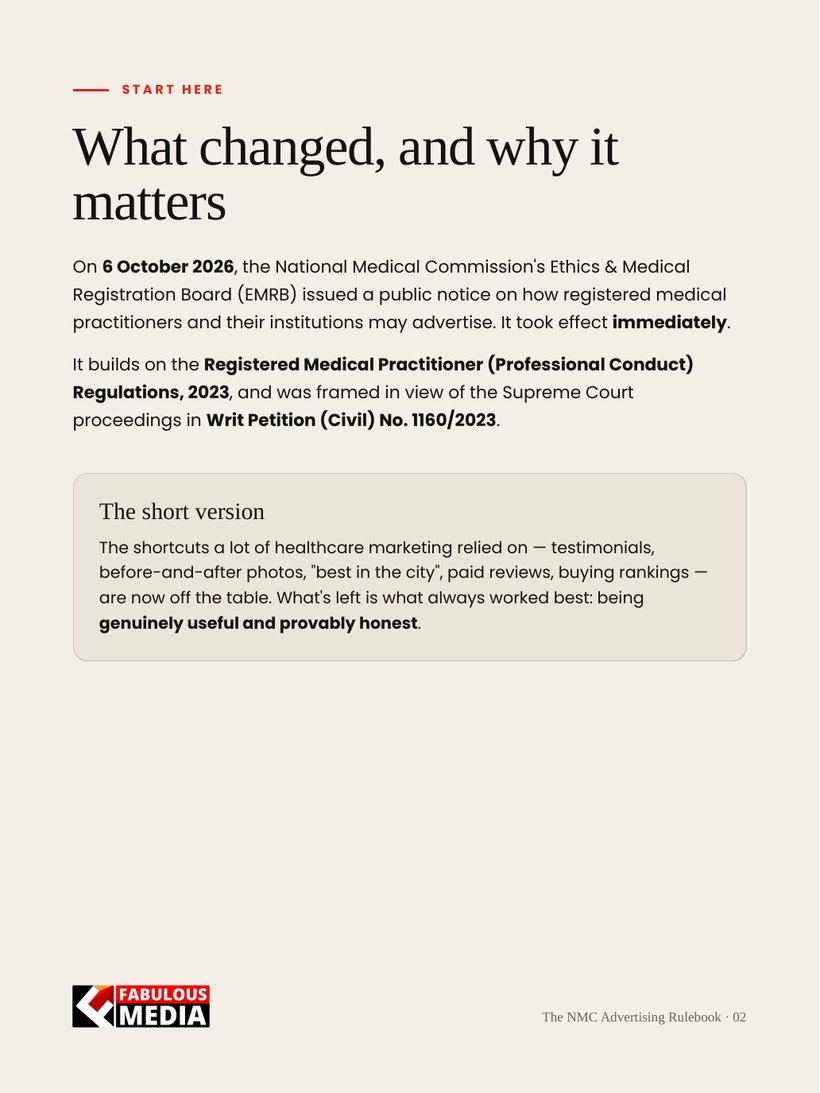
If your hospital, clinic or practice markets itself online, the ground shifted this week. The NMC’s Ethics and Medical Registration Board (EMRB) issued a public notice on 6 October 2026 that spells out how registered medical practitioners and the institutions they work in may — and may not — advertise. It applies with immediate effect.
It sits on top of the Registered Medical Practitioner (Professional Conduct) Regulations, 2023, and was framed in view of the Supreme Court proceedings in Writ Petition (Civil) No. 1160/2023. We’ve read the notice and the underlying regulations so our clients don’t have to. This is the summary we’re using internally, shared in the open.
The one-line version
The shortcuts that a lot of healthcare marketing leaned on — patient testimonials, before-and-after photos, “best in the city”, “100% success”, paid reviews, buying your way to the top of search — are now explicitly off the table. What’s left is the thing that was always the strongest play anyway: being genuinely useful and provably honest.
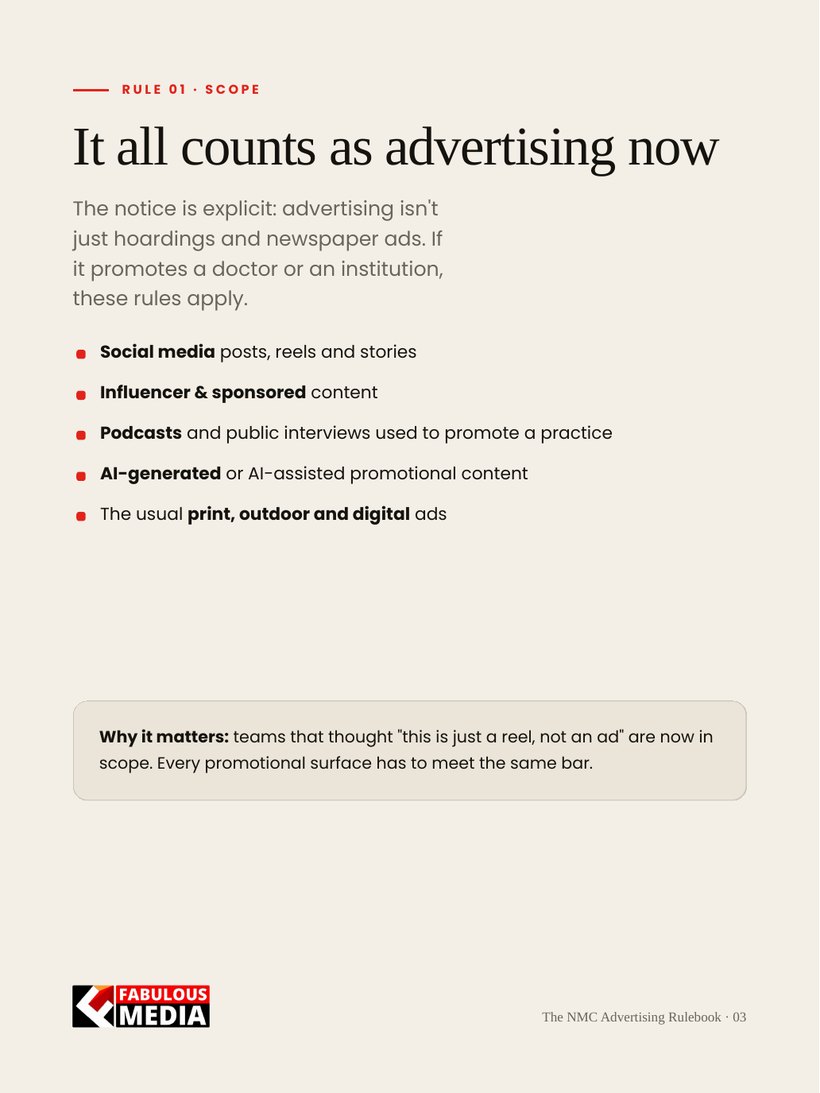
What now counts as “advertising”
This is the part most people miss. The notice is explicit that advertising isn’t just hoardings and newspaper ads. It covers:
- Social media posts, reels and stories
- Influencer and sponsored content
- Podcasts and public interviews used to promote a practice
- AI-generated or AI-assisted promotional content
- The usual print, outdoor and digital ads
If it promotes a doctor or an institution, it’s advertising — and the rules below apply to it.
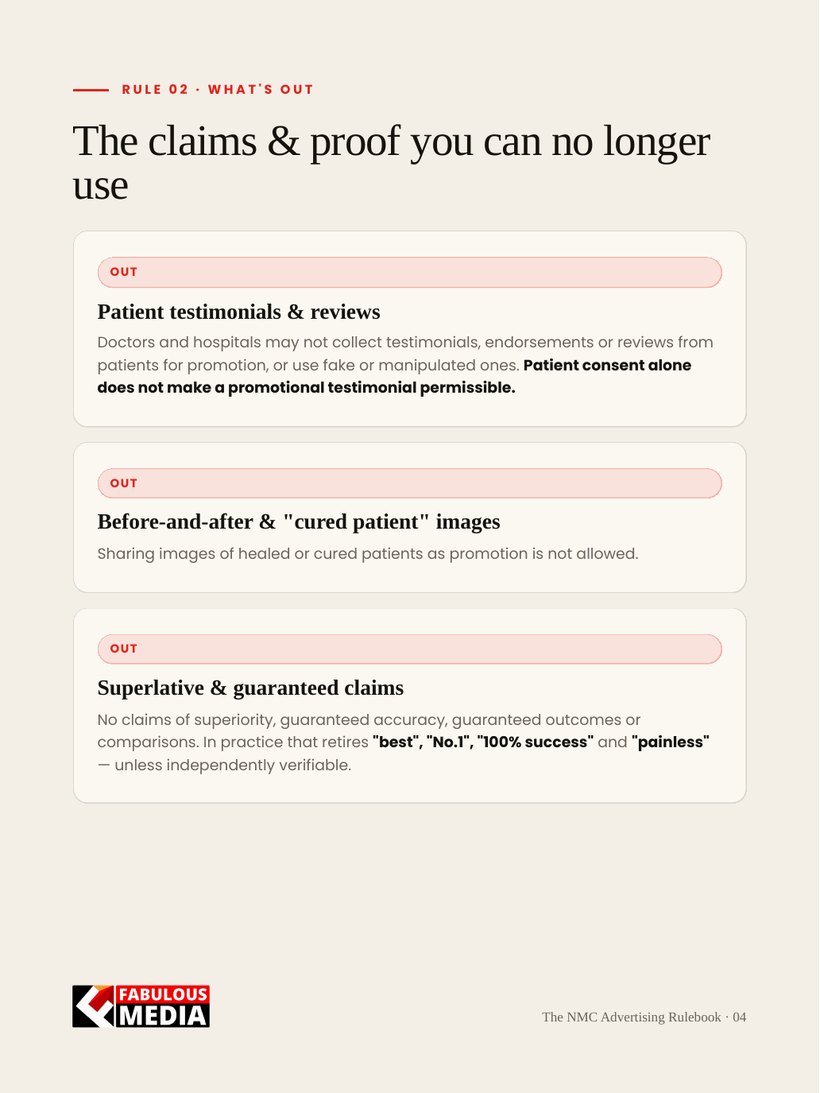
What’s out
Patient testimonials, endorsements and reviews. A doctor or hospital may not request testimonials, endorsements or reviews from patients to use in social media promotion, and may not use fake or manipulated ones. Crucially, patient consent on its own does not make a promotional testimonial permissible.
Before-and-after and “cured patient” imagery. Sharing images of healed or cured patients as promotion is out.
Superlative and guaranteed claims. Factual information about equipment and facilities is fine. Claims of superiority, guaranteed accuracy, guaranteed outcomes, and comparative claims are not. In practice that retires “best”, “No.1”, “100% success” and “painless” unless the claim is independently verifiable.
Paid and fake reviews — and paid-for ranking. No paying for reviews, likes or followers. The regulations also bar paying so that search algorithms push a name to the top. Earning rankings with genuinely useful content is a different thing — see below.
Unlabelled AI promotion. AI-generated or AI-assisted promotional content is permitted, but it must carry a clear disclosure that its origin is AI. Synthetic patients, synthetic endorsements, and AI claims about diagnosis, treatment, outcomes or qualifications are not allowed. Purely commercial AI promo campaigns are prohibited.
Soliciting patients, directly or indirectly. Practitioners may not solicit patients, including through online forums or agents engaged to procure patients. If your marketing is paid or structured around procuring individual patients, that arrangement needs a hard review now.
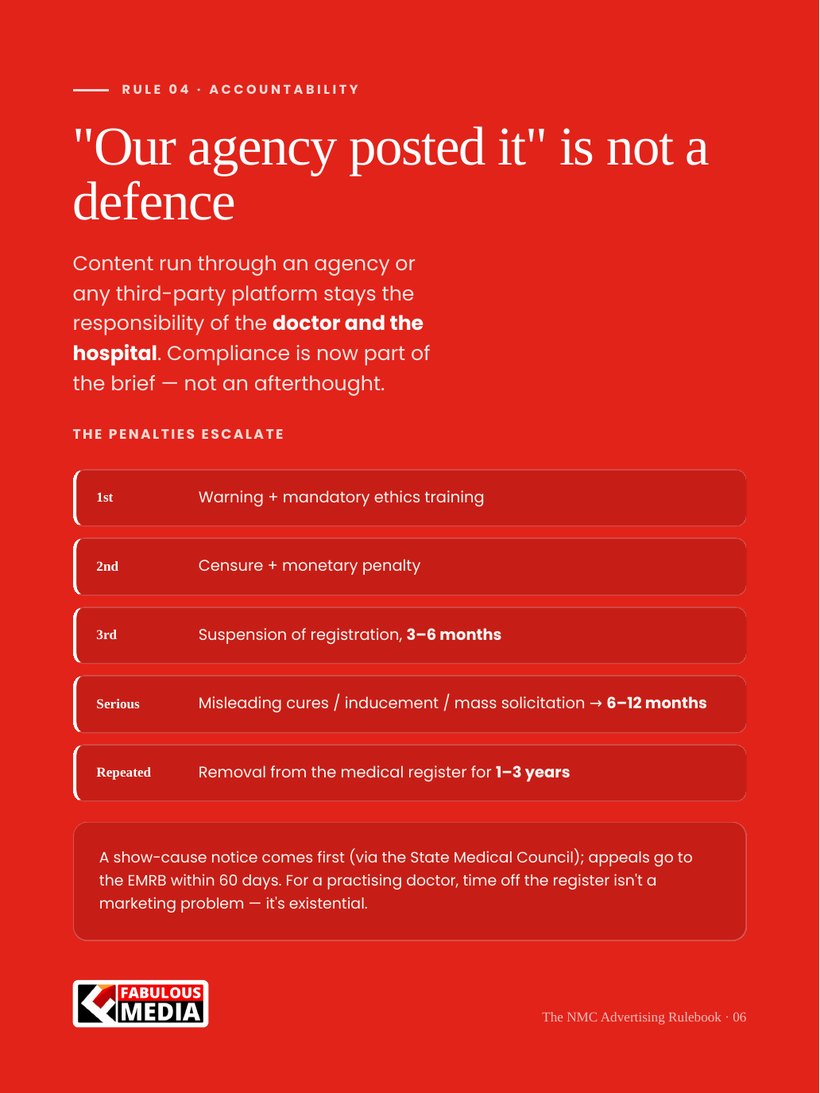
“Our agency posted it” is not a defence. The accountability stays with the practice.
The notice treats content published through an advertising agency or a third-party platform as the responsibility of the doctor or the institution. That’s the line that should change how every healthcare brand chooses and briefs its agency — compliance is now part of the deliverable, not an afterthought.
The penalties are real, and they escalate
Enforcement runs through the State Medical Council, which issues a show-cause notice before any penalty; practitioners can appeal to the EMRB within 60 days. The consequences are graded:
- First violation: warning and mandatory ethics training.
- Second violation: censure and a monetary penalty.
- Third violation: suspension of registration for three to six months.
- Serious violations — misleading cure claims, patient inducement, mass digital solicitation — suspension for six to twelve months.
- Repeated violations: removal from the medical register for one to three years.
For a practising doctor, time off the register is not a marketing problem. It’s an existential one. That is the right lens for this.
What still works — and works better now
Here’s the part we actually believe: this is good for patients, and good for healthcare marketing. When the shortcuts go, the brands that invested in substance win by default. All of the following are squarely allowed:
- Health education and awareness — public-health, academic and educational content, as long as it isn’t soliciting patients or promoting a personal practice. The single biggest open lane.
- Factual information — clear facts about departments, specialities, facilities, equipment, qualifications and fees, stated plainly, without superlatives.
- A website that answers the question before the call — the most compliant, most effective asset a hospital can own.
- Legitimate SEO — buying rankings is out; earning them with useful, accurate, well-structured content is now the main way to be found.
- Consented, de-identified stories where the law permits — the bar is high; it is not zero.
- Labelled, honest AI — fine when it’s disclosed and a human has checked every claim against the source.
This isn’t India going it alone
For anyone working across markets, this will feel familiar. Australia has restricted testimonials in regulated health advertising for years. Fake and incentivised reviews are under active scrutiny in North America. India is moving in the same direction as the rest of the regulated world, not away from it. Building a compliant healthcare marketing engine now is also future-proofing it.
What we’re doing about it
We’re reviewing every healthcare account we manage against the 6 October notice this week — auditing live social content, ad campaigns, review-generation practices, agency fee structures and AI usage, and flagging anything that needs to change. Where a tactic is now off-limits, we’re replacing it with the compliant version that does the same job: education instead of testimonials, factual authority instead of superlatives, earned rankings instead of bought ones.
Not sure where your current marketing stands against the new rules? That’s exactly the review we can run for you — a compliance-first healthcare marketing audit.
Sources: NMC EMRB public notice dated 6 October 2026; Registered Medical Practitioner (Professional Conduct) Regulations, 2023; Writ Petition (Civil) No. 1160/2023. This article is a plain-language summary for marketers and is not legal advice; for compliance decisions, read the full NMC notice and consult your medico-legal advisor.